How many Australian businesses use AI? Published answers run from 12 to 88 per cent because they count different things. What each figure measures, sourced.
Key takeaways
- The Australian Bureau of Statistics found 12 per cent of employing businesses used AI in 2024–25: 35 per cent of large businesses, 22 per cent of medium ones and around 11 per cent of small and micro businesses.
- The government’s AI Adoption Tracker puts small and medium business adoption at 43 per cent, but that counts some level of adoption, and only 7 per cent of those businesses report broad use of AI.
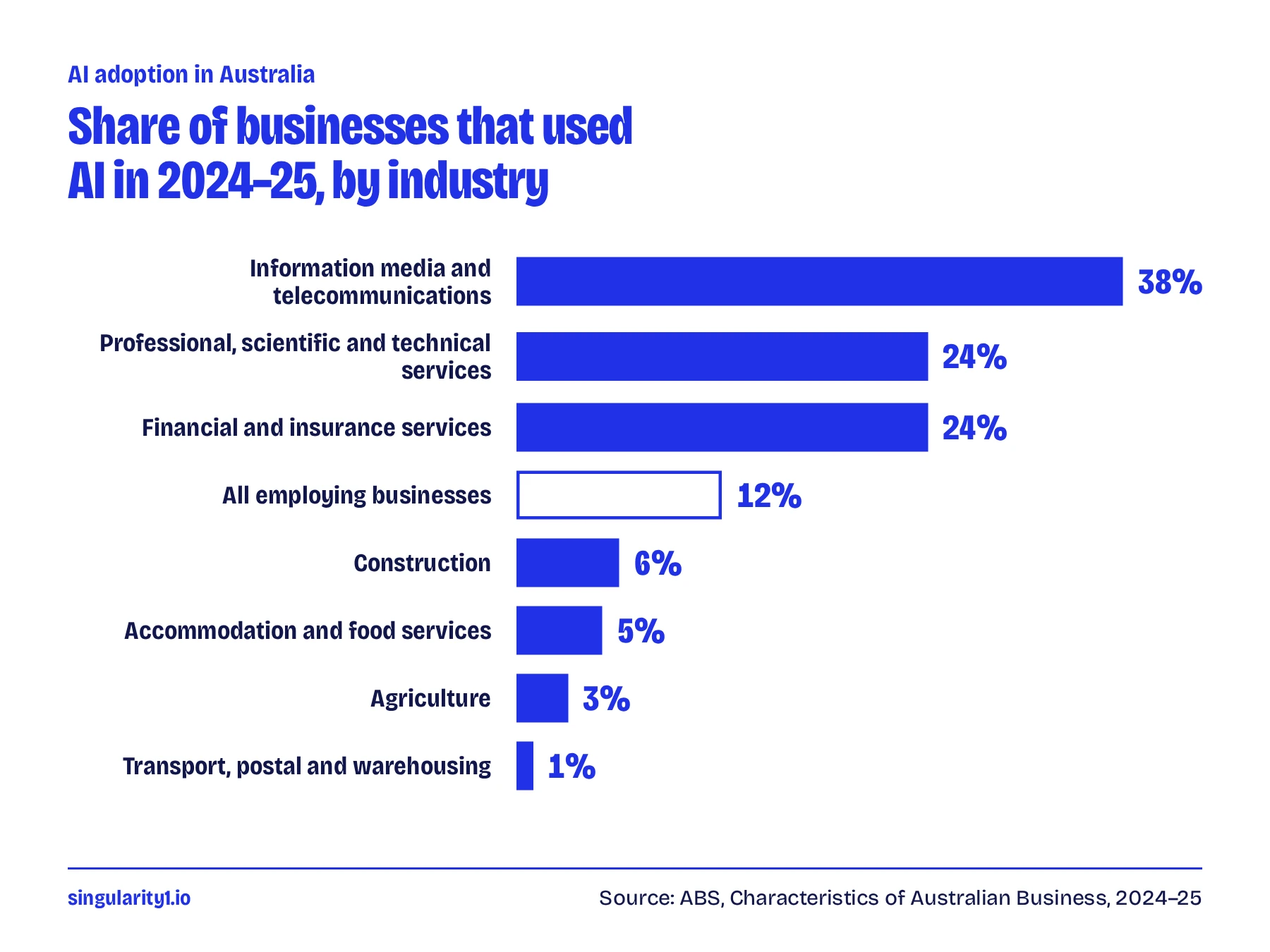
- Use varies most by industry: 38 per cent of information media and telecommunications businesses used AI in 2024–25, against 6 per cent in construction and 1 per cent in transport, postal and warehousing.
Ask how many Australian businesses use AI and you will find answers from 12 per cent to 88 per cent. Most of them are not wrong. They measure different things: different kinds of business, different sample sizes and very different definitions of using AI.
This page keeps the figures from the Australian Bureau of Statistics (ABS), the government’s own tracker and the Reserve Bank, says what each one measures, and lists the industry studies with who paid for them. It is updated at this same address when new official figures come out.
The official figure: 12 per cent
The most reliable count is the ABS Business Characteristics Survey, which asked nearly 7,000 employing businesses about the 2024–25 financial year. Almost one in eight, 12 per cent, said they used AI. The ABS puts its earlier figure at 1 per cent, so use has grown more than tenfold in a few years, led by bigger businesses.
| Business size | Used AI in 2024–25 | Earlier ABS figure |
|---|---|---|
| Large, 200 or more staff | 35% | 9% in 2021–22 |
| Medium, 20 to 199 staff | 22% | 3% in 2021–22 |
| Small and micro | Around 11% | Not in the release |
| All employing businesses | 12% | 1% |
Businesses that innovate are far more likely to use AI: 20 per cent of innovation-active businesses used it in 2024–25, against 6 per cent of the rest. Among small businesses the gap is 19 per cent against 4 per cent. The ABS plans more AI questions for its 2026–27 survey.
Which industries use AI most
The same ABS survey shows a wide spread between industries. The figures below are the share of businesses in each industry that used AI in 2024–25.
Read the chart as text
AI use by industry in 2024–25. The outlined bar is the figure for all employing businesses. Source: ABS. Bar chart of the share of Australian businesses that used AI in 2024–25, by industry, from the ABS Characteristics of Australian Business survey: information media and telecommunications 38 per cent; professional, scientific and technical services 24 per cent; financial and insurance services 24 per cent; all employing businesses 12 per cent; construction 6 per cent; accommodation and food services 5 per cent; agriculture 3 per cent; transport, postal and warehousing 1 per cent.
| Industry | Used AI |
|---|---|
| Information media and telecommunications | 38% |
| Professional, scientific and technical services | 24% |
| Financial and insurance services | 24% |
| Construction | 6% |
| Accommodation and food services | 5% |
| Agriculture | 3% |
| Transport, postal and warehousing | 1% |
Our reading of the spread: AI has gone furthest where the work already happens on a screen. Where the work is physical, on a site, a farm or a truck, AI has so far reached the office around the job, the quotes, bookings, invoices and reports, rather than the job itself.
The government’s tracker: 43 per cent, and what it counts
The National AI Centre’s AI Adoption Tracker surveys about 400 small and medium businesses a month, from sole traders to firms of 500 staff. Its latest quarterly write-up, for December 2025 to February 2026, reported that 43 per cent of SMEs had some level of AI adoption.
That is not the same as current use. The tracker’s adopting group appears to include businesses planning to bring AI in within 12 months, and narrower cuts tell a different story. The National AI Plan cites the tracker for over one third of SMEs having adopted AI, with regional businesses at 29 per cent against 40 per cent in the cities. In May 2026 the Assistant Minister for Productivity, Andrew Leigh, wrote that just 7 per cent of small and medium enterprises make broad use of AI.
The tracker also shows why the rest hold back. About 65 per cent of businesses not using AI distrust AI decisions or prefer human control, 54 per cent say it is not relevant to them, and 19 per cent do not know how to use it. Among businesses using AI, the most common uses are content generation and data analytics, at 54 per cent each, then cybersecurity at 48 per cent.
Bigger firms: two-thirds use it, few use it deeply
The Reserve Bank’s liaison program interviewed 105 medium and large firms between June and August 2025. About two-thirds were using AI in some form, but around 40 per cent described their use as minimal and about 30 per cent reported substantive progress. Fewer than 10 per cent had no plans to adopt it, and about half expected AI to slightly reduce their headcount over three years.
The Treasurer made the same point in September 2026: two-thirds of businesses have adopted AI in some form, but fewer than 10 per cent describe it as significant.
The bigger picture
- The Productivity Commission’s final report on the data and digital economy, released in December 2025, estimated AI could lift multifactor productivity by more than 2.3 per cent over the coming decade.
- Business spending on AI research and development grew 142 per cent between 2021–22 and 2023–24, making AI the fastest-growing area of business research and development, according to the ABS.
- Jobs and Skills Australia estimates, as summarised by the Reserve Bank, that about 4 per cent of the workforce is highly exposed to automation by AI, while around 90 per cent of jobs have medium to high exposure to AI helping with parts of the work.
Industry studies, and who paid for them
Industry surveys report higher figures. They often draw on customer panels, count any use at all, or cover bigger firms only. They are still useful when read with their funding in mind.
| Study | What it found | Run or paid for by |
|---|---|---|
| Deloitte Access Economics, November 2025 | Two-thirds of small and medium businesses use AI; 5% are fully enabled | Commissioned by Amazon; 1,000+ businesses |
| Strand Partners, August 2025 | 50% of businesses regularly use AI | Commissioned by AWS |
| QuickBooks AI impact report, May 2026 | 69% of small businesses use AI regularly; 28% daily | Intuit; 3,790 owners |
| NAB SME survey, April 2026 | 42% of SMEs use AI; 44% do not | NAB |
| MYOB Business Monitor, April 2026 | 46% of SMEs neither use AI nor plan to within 12 months | MYOB; 1,000+ SMEs |
| auDA small business report, July 2026 | 72% of small businesses have used AI | auDA with SEC Newgate; 408 small businesses |
| CPA Australia, October 2026 | 88% of businesses use AI; 10% have it deeply embedded | CPA Australia; 1,679 finance professionals in five markets |
What the numbers mean for a business deciding now
Read together, the figures say one thing. Most businesses have tried AI, usually a chat tool for writing. Few have built it into how the business runs: 7 per cent of small and medium businesses report broad use, and fewer than 10 per cent of businesses call their use significant.
The gap is not access to the tools, which are cheap and everywhere. It is turning a tool into a system that does a whole job, end to end, on the software the business already uses, with a person in control. That gap is where the return is, and it is the work we do.
Sources
- ABS: Characteristics of Australian Business, 2024–25
- ABS: Business adoption of artificial intelligence accelerates in 2024–25 (25 June 2026)
- ABS: AI now the fastest-growing area of business R&D (22 August 2025)
- National AI Centre: AI adoption insights, December 2025 to February 2026
- National AI Plan: spreading the benefits
- Andrew Leigh: only 7 per cent of Australian businesses broadly use AI (15 May 2026)
- Jim Chalmers: address to the 2026 Australia and the World annual lecture (21 September 2026)
- Reserve Bank of Australia: technology investment and AI, what are firms telling us? (November 2025)
- Productivity Commission: data and digital technology inquiry, final report (December 2025)
- Deloitte Access Economics for Amazon (November 2025)
- AWS: new research shows one Australian business adopts AI every three minutes (August 2025)
- Intuit QuickBooks: AI impact report, Australia 2026
- NAB: small business in the driver’s seat of Australia’s AI shift
- MYOB Business Monitor (April 2026)
- auDA: too small to be a target? (July 2026)
- CPA Australia: Aussie businesses risk falling behind in AI race (October 2026)